The Missing Piece in Every AI Upskilling Program
AI is driving the largest workforce reskilling event in history.

Published ahead of ATD International Conference & EXPO 2026 | Los Angeles, May 17–20
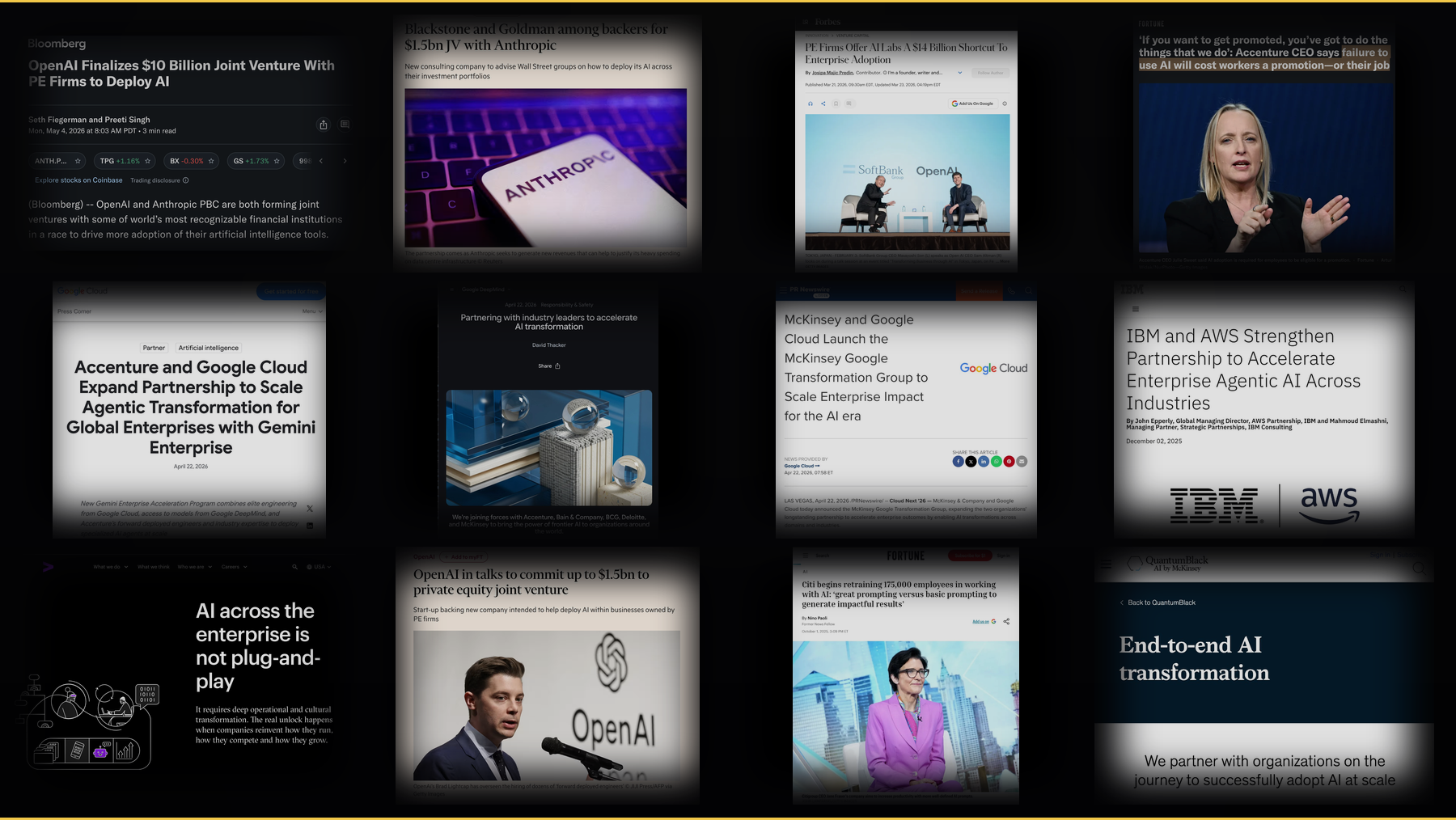
Every major lab, hyperscaler, and consultancy is investing at unprecedented scale to make sure enterprise workforces can actually use the tools being deployed. The numbers are staggering.
- $10B+ OpenAI Frontier Alliances with BCG, McKinsey, Accenture, and Capgemini (Bloomberg, Feb 2026)
- $1.5B+ Anthropic joint venture with Blackstone, Hellman & Friedman, and Goldman Sachs (Financial Times, May 2026)
- Claude deployed to 470,000 Deloitte professionals — with formal credentialing for 15,000 (Anthropic + Deloitte, Oct 2025)
- Agentic transformation partnership between Accenture and Google Cloud, with an explicit workforce readiness component (April 2026)
These announcements share a common thread. AI adoption has crossed from experimentation into workforce transformation. The mega-firms will be fine — they have direct attention from every lab and consultancy on the planet.
What about everyone else?
The US has more than 6 million employer firms — and the vast majority lack enterprise-scale AI upskilling infrastructure. The World Economic Forum estimates 85% of employers plan to prioritize upskilling their workforce. Yet according to the WEF's Future of Jobs 2023 report, 60% of workers will require reskilling by 2027 — and only half currently have access to sufficient training.
Most of those mid-market employers running AI training today cannot answer one basic question:
When an employee finishes the program, what do they have that lasts?
Vendor badges close when the vendor relationship closes. LMS completion records disappear at the next model cycle. Internal training records are invisible to a future employer.
This is not a content problem. It is a credentialing architecture problem.
The Woolf Ecosystem
Woolf is an accredited higher education institution following the European ECTS framework, with internationally portable academic credit recognized in 50+ countries and mapped to real competencies. Woolf delivers fully online degrees to 15,000+ enrolled students through more than 30 Woolf colleges.
Woolf sits at the foundation of the AI upskilling stack — connecting deployment, training, and workforce adoption to durable academic credit.
DEPLOY → TRANSFORM → LEARN → CREDENTIAL
AI labs and PE-backed operators deploy models into live company workflows. Workflows transform. People learn. Woolf credentials the learning — as accredited academic progress that follows the employee.
| What other AI upskilling programs provide | What Woolf provides |
|---|---|
| Vendor certificates that close with the vendor | Accredited Woolf degrees |
| LMS completion records | Internationally portable academic credit mapped to real competencies |
| Internal employer badges | Recognition across 50+ countries |
| Vendor-locked learning records | Records that follow the employee |
Beyond Accreditation — Talent Intelligence
Accreditation is the floor, not the ceiling. Woolf's talent intelligence platform gives every learner a live competency model — a continuously updated record of what they know, can do, and are becoming. This is not a static transcript handed over at the end of the program. It is built from real work artifacts and assessments, not from course completions alone.
Here is what makes the model live:
- Every learning objective in every program maps to verified knowledge, skills, and competencies, measured across 1,000+ benchmarks
- The record updates continuously as new evidence arrives, rather than once a year as a snapshot
- Each learner is benchmarked against peers, cohorts, and role outcomes, so the capability data is comparable rather than just descriptive
- Evidence is approval-gated and signed by Woolf faculty, so every claim on the transcript is auditable
- Work artifacts, learning, and academic progress sit on a single durable record that follows the employee across roles and employers
This changes the boardroom conversation from “did the training happen?” to “can we demonstrate workforce capability in a form an external party would recognize?” It gives L&D leaders, boards, and investors capability data they can actually rely on.
The Questions to Ask Before Finalizing Your AI Upskilling Strategy
- When an employee completes this program, what do they have they can take with them?
- How will we demonstrate workforce capability to our board, investors, or customers?
- If we change AI platform vendors in 18 months, will the learning investment carry forward?
- Are employees more likely to adopt and retain AI workflows if a recognized outcome is attached?
These are not academic questions. They are operating questions, and they have an answer.
Our Positioning
Woolf is not another online university. Woolf is regulated infrastructure for the age of retraining.
We do not need to pick the winning AI model or write the training content. It provides the accreditation infrastructure, compliance, and credit-recognition system that lets real learning count.
The Opportunity in Front of Us
The firms that lead the AI era will not be the ones deploying the most tools — they will be the ones building the most capable workforces. Capability requires evidence. Evidence requires infrastructure. Infrastructure requires institutional credibility.
That foundation already exists. What we are building now is the enterprise layer of it: the ability for any organization running AI implementation programs to connect that work to genuine academic progress for their employees.
AI training without a credential architecture is a leaky bucket. You can keep filling it, but the learning, the capability, the workforce transformation flow out at the same rate they flow in. The organizations with the most capable AI-enabled workforces in five years will be the ones building durable learning infrastructure today — not the ones running the most workshops.
Joshua Broggi is the Head of Institution at Woolf, accredited by the MFHEA (Licence No. 2019-015) and operating globally with 15,000+ enrolled students across 50+ countries.
Explore Woolf's enterprise AI programs: labs.woolf.university | Book a call: labs.woolf.university/book-a-consultation

You might like these other news articles




Stay up to date with Woolf
Subscribe now for educational innovations, Woolf updates, and academic insights