How to verify your Woolf degree: three checks every student can make
Your enrollment documents, your teachers in Woolf’s faculty directory, and your degree in Woolf’s own records.

Summary: Woolf’s license as a Higher Education Institution runs to 23 December 2029, across all degree levels, and Woolf remains one collegiate institution whose colleges are internal academic units. If you want to confirm your own standing, there are three checks you can make yourself: the enrollment documents Woolf issued to you, the Woolf faculty who teach you, and your degree in Woolf’s records. If you signed a Woolf enrollment agreement and hold a Woolf student ID card, you are a Woolf student, whenever you enrolled: your program is accredited and your degree is awarded by Woolf.
Since we wrote about the renewal of Woolf’s license, students have asked us a more personal version of the same question: how do I know that my degree is legitimate? This article explains three ways you can verify this yourself, based on documents you already hold and on Woolf’s public record. Together they cover the three things that make a degree legitimate: your enrollment, your teachers, and your degree. If you are thinking of enrolling, you can make the second and third checks before you sign.
1. Your enrollment documents
You join Woolf by enrolling, and your enrollment begins when you sign your Woolf enrollment agreement. Woolf generates that agreement and keeps your signed copy, and it takes effect once Woolf’s central administration has approved your admission and your agreement has been countersigned. Nobody else can enroll you in a Woolf degree, and nobody else has ever been able to.
Your enrollment agreement. What you signed is a package of three agreements: the Woolf Agreement, between you and Woolf as the licensed Higher Education Institution; the College Agreement, between you and your Woolf college; and the Program Enrollment Agreement, which sets out the terms, tuition and details of your program.
Your enrollment letter. Woolf issues your Letter of Enrollment on Woolf letterhead, signed by the President under Woolf’s license number, 2019-015. It names your degree and your college, and it describes your college as a constituent college of Woolf.
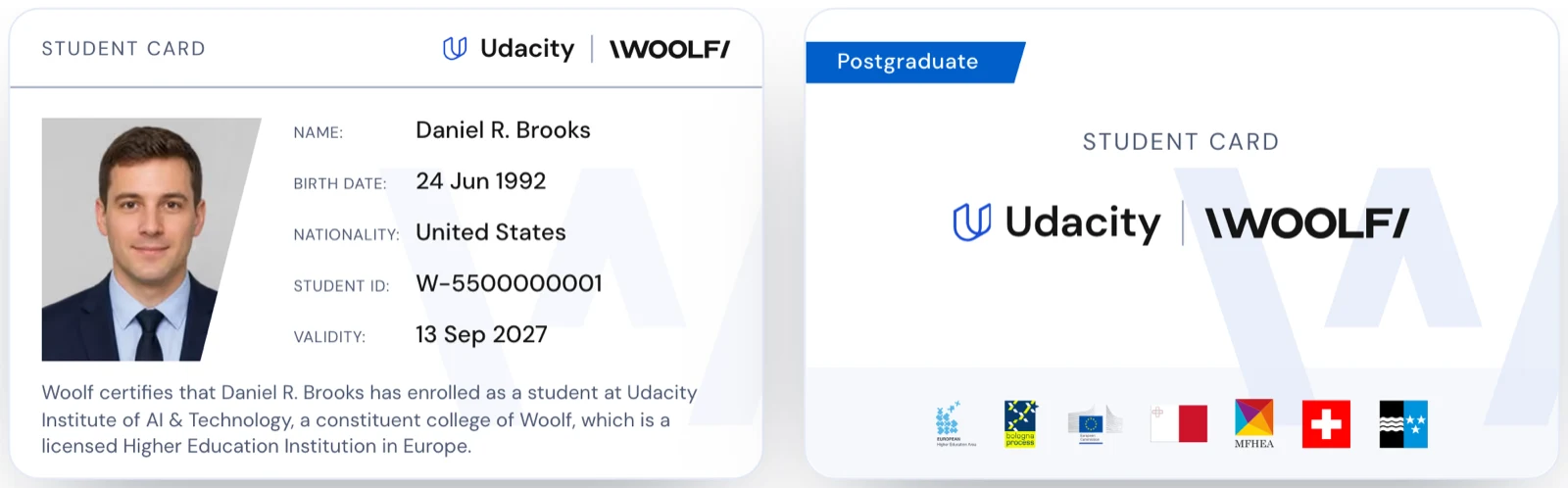
Your student ID card. Every Woolf student holds a Woolf student ID card with a Woolf student ID. The card carries your college’s name and logo beside Woolf’s, a badge for your degree level, the emblems of the authorities under which Woolf is accredited, and this certification: “Woolf certifies that [your name] has enrolled as a student at [your college], a constituent college of Woolf, which is a licensed Higher Education Institution in Europe.”
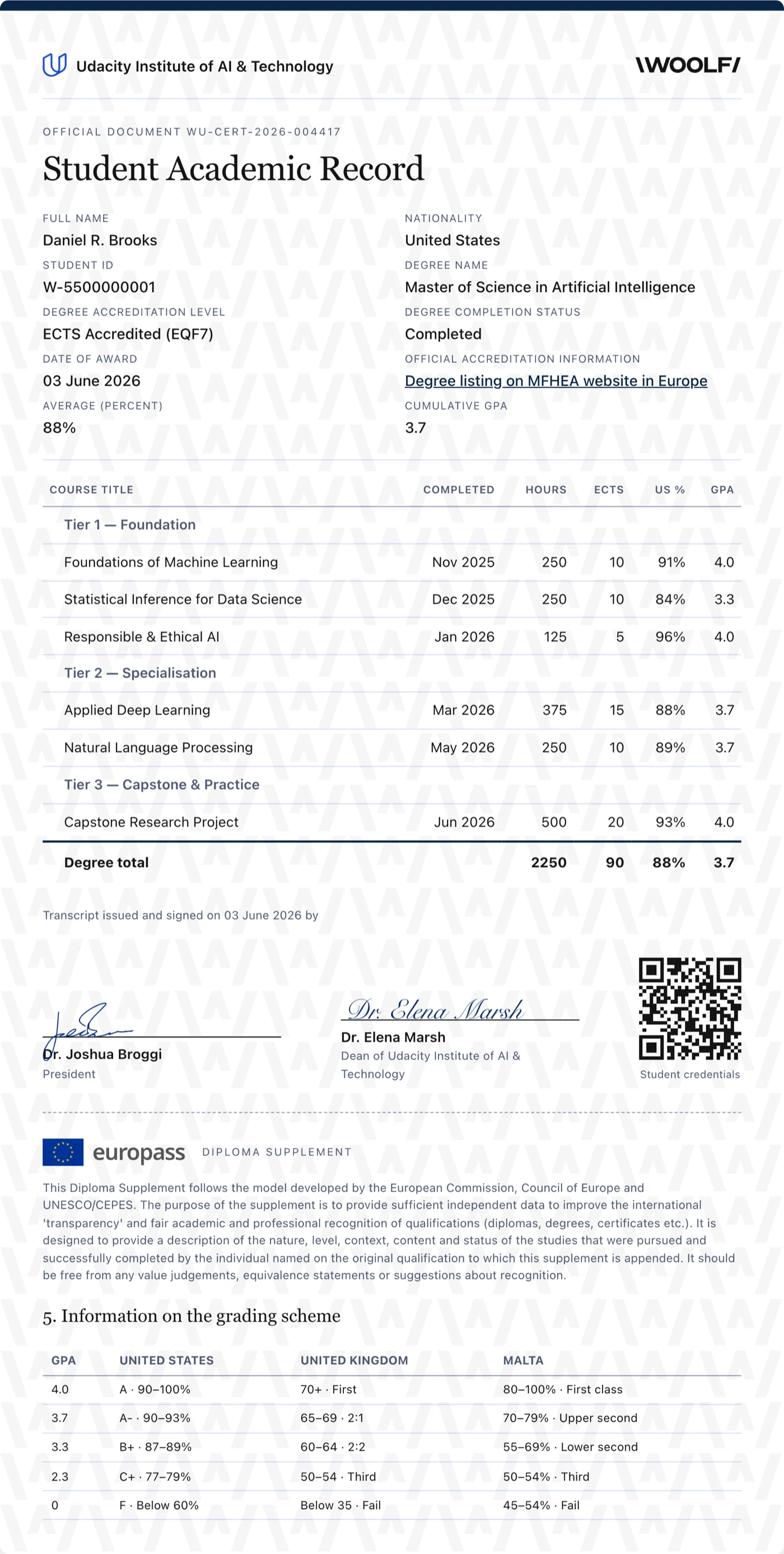
Your transcript. Your academic record is issued by Woolf and signed by the President and by the Dean of your college. It lists every course with its hours, ECTS credits and grades.
If you are a non-college Woolf student, your documents are the same, and they name Woolf wherever a college’s name would otherwise appear.
Whenever you enrolled. Students who enrolled on or after 1 September 2026 are enrolled on exactly the same footing as those who enrolled before that date: the same agreement, the same documents, the same accredited program and the same Woolf degree.
If you hold these documents, you are a full member of Woolf: your program is accredited, and your degree is awarded by Woolf. If you are a Woolf student and you cannot find them, write to the Registrar at registrar@woolf.education.
2. Your teachers are Woolf faculty
Teaching at Woolf is done by Woolf. Every faculty member has signed their faculty agreement with Woolf, and every faculty member has a Woolf email address. Before anyone teaches, they verify their identity and their academic credentials with Woolf and are accepted by their peers, as our Quality Assurance Policy requires. Each college has an Academic Board of research doctorate holders, which is responsible for the academic integrity of the college’s curriculum.
You can check your teachers against the public record. Every member of Woolf’s faculty is listed, A to Z, in the Woolf faculty directory, with their Woolf email address. The invitation to enroll that you accepted names the teachers on your course. If someone teaching you is not in the directory, tell the Registrar.
3. Your degree is a Woolf degree
Woolf is one collegiate institution, and its colleges are internal academic units within it. That is how Woolf has been constituted since 2019 under its Quality Assurance Policy, which the Authority has continually approved. Woolf’s license was renewed to 2029 without any change to its constitution: Woolf remains one collegiate institution. Teaching, admissions, academic standards, internal quality assurance and the award of degrees are all functions of Woolf, under its central administration.
Check your degree in Woolf’s records. Your transcript states the accreditation level of your degree and links to Woolf’s listing on the MFHEA’s register of qualifications, where your degree appears. The QR code on your transcript, and on your degree certificate when you graduate, opens your credentials page in Woolf’s records, where anyone you share it with can confirm the credential. Our Credential Verification Services page describes how employers and other institutions verify Woolf credentials.
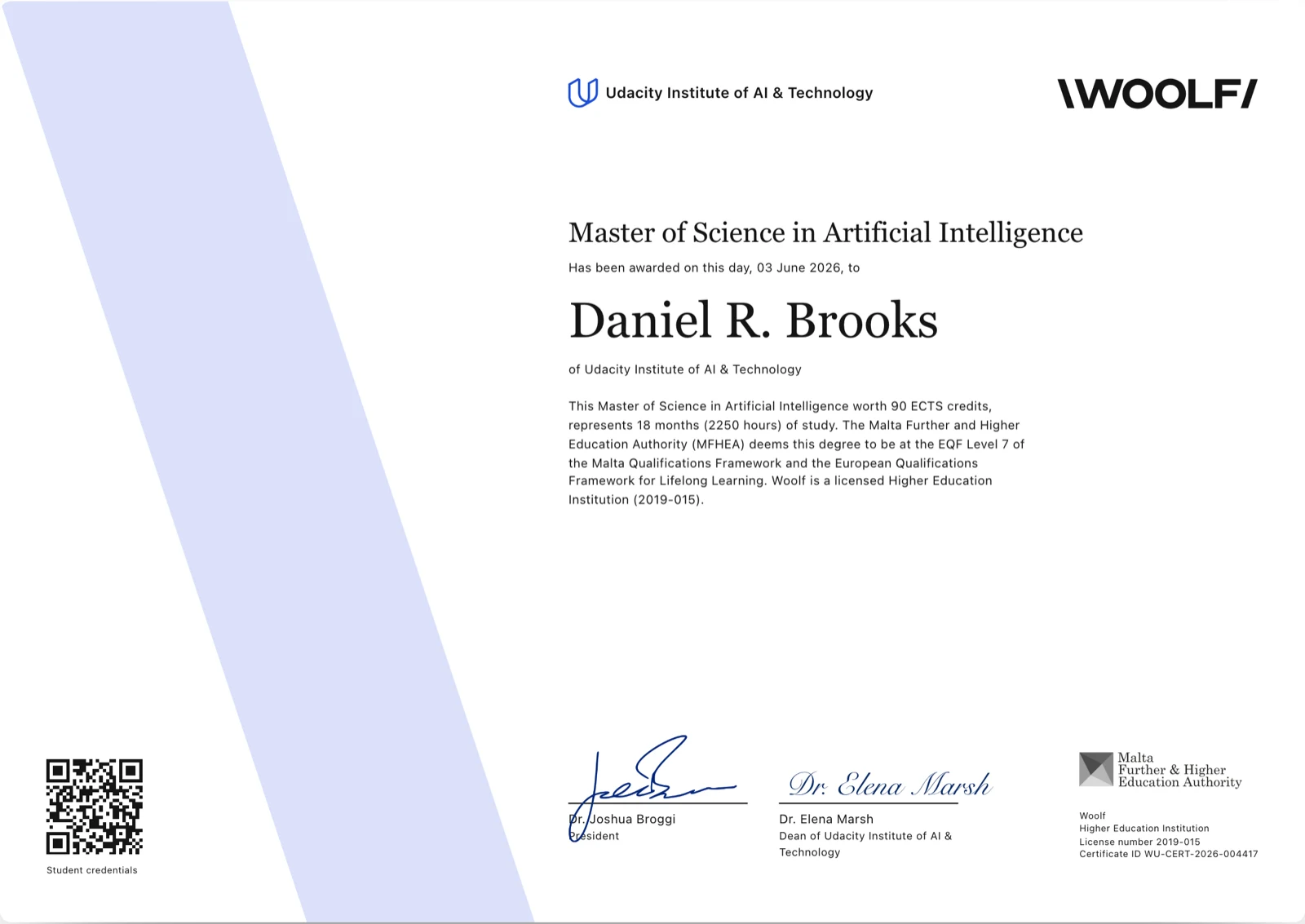
If you study at a college, you can also find it in the public list of Woolf colleges: woolf.education/colleges-a-z. Every degree certificate Woolf issues to a college student has been approved by the Authority naming and displaying both Woolf and the Woolf college, and every degree is listed on our website next to the college that offers it.
What a sponsor is. Many Woolf colleges have a sponsor: an organization that supports the college. A sponsor is the guarantor of the college’s finances, and in return it may propose the college’s name, logo, dean, faculty and curriculum, and recruit and propose students to the college. A sponsor is not a higher education institution, holds no accreditation of its own, and does not become a college: the college is created by Woolf and is an integral academic unit of Woolf. Woolf Labs, which provides Woolf’s technology platform, explains the model at labs.woolf.education/understanding.
Who has academic authority. Only Woolf. Woolf faculty teach a Woolf curriculum to Woolf students. A sponsor cannot admit students, determine the curriculum, set grades or decide a student’s progression; it does not teach students and it does not graduate them. Everything a sponsor proposes, from a dean to a course, takes effect only when Woolf approves it under its Quality Assurance Policy.
Woolf’s badge on sponsor websites. Woolf is adding a status badge and a short explanation of the relationship to its sponsors’ websites. Both are served by Woolf and synced to the records of Woolf’s central administration, so they describe the relationship correctly: the sponsor supports a college of Woolf, whose faculty, curriculum and degrees are Woolf’s. If a college’s status in Woolf’s records changes, the badge changes with it.
One institution, one answer
Your enrollment is with Woolf. Your teachers are Woolf faculty. Your degree is awarded by Woolf. Each of those is a fact you can check, and if a question remains, contact us.
Your three checks
- Your enrollment documents: a signed Woolf enrollment agreement, a Letter of Enrollment, a Woolf student ID card, and a transcript issued by Woolf.
- Your teachers: Woolf faculty, listed with their Woolf email addresses in the Woolf faculty directory.
- Your degree: a Woolf degree, confirmed on your transcript and credentials page and, if you study at a college, offered by a college in the A to Z of Woolf colleges.

You might like these other news articles





Stay up to date with Woolf
Subscribe now for educational innovations, Woolf updates, and academic insights